


From Laboratory Innovation to Industrial Reality: The Scale-Up and Industrialization Challenge
Innovation is the engine that drives industrial progress. Every year, universities, research centers, startups, technology developers, and industrial companies invest significant resources in the development of new materials, chemicals, polymers, biotechnology platforms, recycling technologies, energy solutions, and advanced manufacturing processes. Many of these innovations demonstrate excellent technical performance at laboratory scale and generate considerable excitement among researchers, investors, and potential customers.
Yet, despite their technical promise, only a small fraction of these technologies ever reach commercial deployment. The reality is that technological success in the laboratory does not automatically translate into industrial success. In fact, one of the greatest challenges facing innovators today is not invention, it is industrialization.
The Gap Between Innovation and Commercial Reality
The path from laboratory discovery to commercial production is often referred to as the “Valley of Death” of innovation. It is the stage where many promising technologies fail, not because they lack technical merit, but because they encounter significant obstacles during scale-up and commercialization.
A process that performs exceptionally well in a laboratory reactor may behave very differently at pilot, demonstration, or industrial scale. Heat transfer, mass transfer, mixing efficiency, residence time distribution, process control, product quality consistency, operability, safety considerations, raw material logistics, utility requirements, environmental compliance, and economics all become increasingly critical as scale increases.
What appears simple in a laboratory environment can become highly complex when translated into an industrial facility processing hundreds or thousands of kilograms per hour.
As a result, many organizations find themselves asking fundamental questions:
- What is the optimal process configuration at commercial scale?
- Which process steps represent the highest technical or operational risk?
- How should the technology be scaled to minimize investment risk?
- Is a pilot plant sufficient, or is a demonstration facility required before commercialization?
- What level of engineering is necessary to support investment decisions?
- What capital investment (CAPEX) and operating costs (OPEX) should be expected?
- What performance improvements are required to achieve commercial viability?
- How can investors, partners, or licensees be convinced of the technology’s value?
- What is the most efficient route to market?
- How can the technology be protected, licensed, and deployed globally?
The answers to these questions often determine whether a technology becomes a successful industrial business or remains a promising laboratory concept.
Industrialization Requires More Than Engineering
Successful industrialization is not merely an engineering exercise. It requires the integration of multiple disciplines, including:
- Process engineering
- Scale-up science
- Equipment and plant design
- Process safety
- Techno-economic analysis
- Investment evaluation
- Market assessment
- Commercialization strategy
- Intellectual property management
- Licensing and business development
The most successful projects are those that address these elements early and systematically, reducing uncertainty before major investments are committed. Organizations that develop a clear industrialization roadmap from the beginning are often able to reduce development timelines, lower technical risks, improve investor confidence, and accelerate market adoption.
Why Technology Scale-Up Matters
Technology scale-up is much more than increasing production volume. It is the process of translating laboratory knowledge into a reliable, safe, economically viable, and commercially attractive industrial operation. Ultimately, successful scale-up transforms innovation into industrial value. Proper scale-up enables companies to:
- Validate technical feasibility under industrial conditions
- Understand process limitations and operating windows
- Improve product quality and consistency
- Reduce operational and investment risks
- Generate reliable design data
- Optimize CAPEX and OPEX
- Strengthen investor confidence
- Accelerate commercialization
- Create a stronger foundation for licensing and global deployment
Technology Scale-Up & Industrialization at Innventik
At Innventik Consulting & Engineering, we support organizations throughout the complete journey from concept development to commercial implementation.
Our multidisciplinary team combines expertise in:
- Process Engineering
- Chemicals
- Polymers
- Elastomers and Rubber
- Advanced Materials
- Biotechnology
- Recycling Technologies
- Sustainable Industrial Processes
- Technology Commercialization
- Industrial Project Development
Our objective is straightforward: Reduce scale-up risks, accelerate commercialization, and transform promising technologies into successful industrial businesses.
Technology Scale-Up
Development of scale-up strategies, identification of critical process parameters, operating windows, equipment selection criteria, and industrial implementation roadmaps.
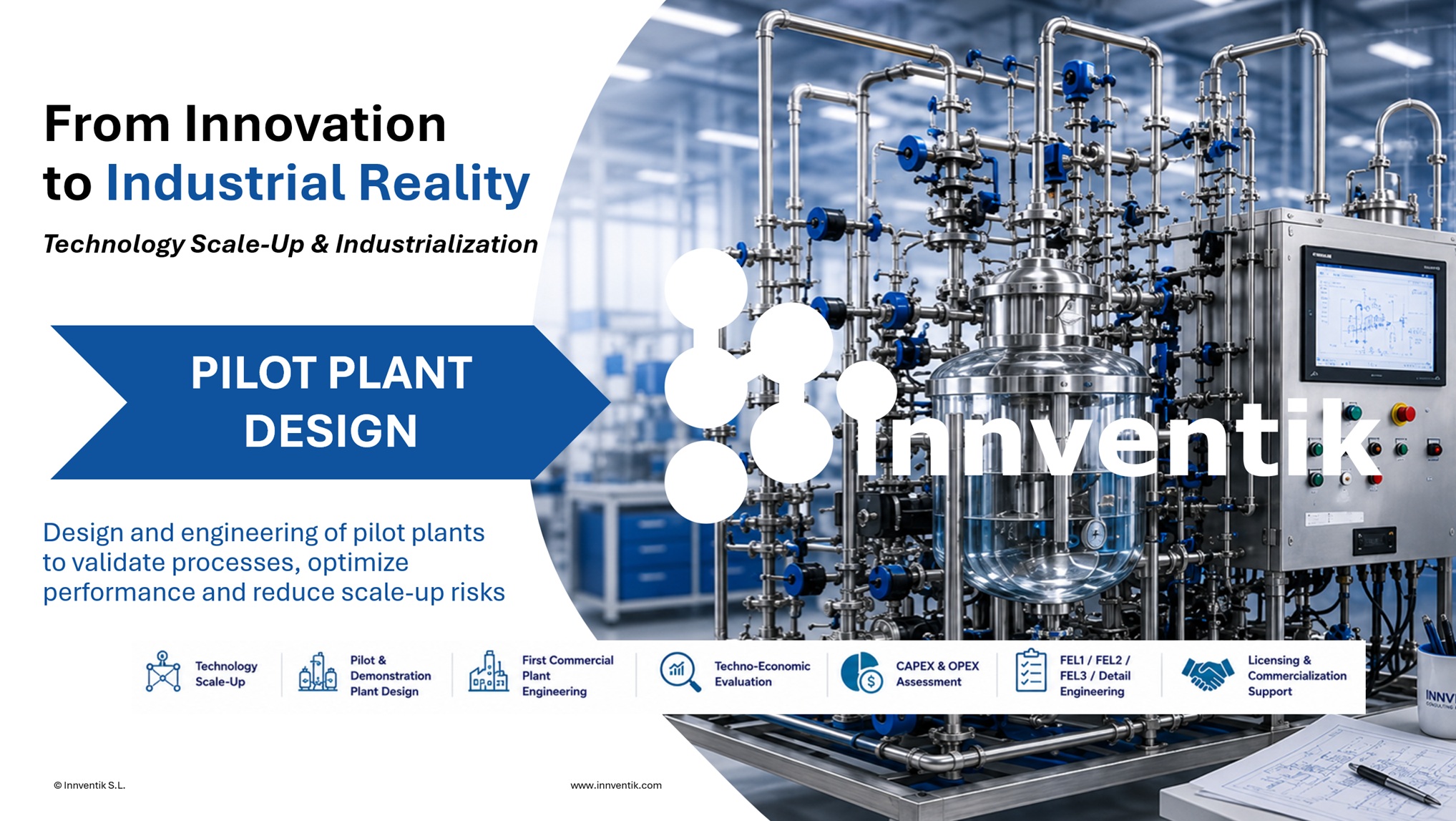
Pilot Plant Design
Design and engineering of pilot facilities used to validate process concepts, generate design data, optimize operating conditions, and support technology development.
Demonstration Plant Design
Engineering of demonstration facilities that bridge the gap between pilot operation and commercial deployment, validating operability, economics, product quality, and market readiness.
First Commercial Plant Engineering
Development of engineering packages for first-of-a-kind industrial facilities, reducing technical uncertainty and investment risk while supporting successful implementation.
Techno-Economic Evaluation
Assessment of process economics, profitability, sensitivity analysis, investment attractiveness, and commercialization pathways.
CAPEX & OPEX Assessment
Preparation of reliable investment and operating cost estimates to support strategic decision-making, fundraising activities, and investment evaluations.
Engineering Development
Comprehensive engineering services covering:
- FEL1 (Conceptual Engineering)
- FEL2 (Basic Engineering)
- FEL3 (Extended Basic Engineering)
- Detail Engineering
Licensing & Commercialization Support
Support in technology positioning, licensing strategies, partner identification, market entry planning, business development, and commercialization roadmaps.
Experience Across Multiple Industries
Innventik has supported industrial development projects across Europe, Asia, and the Americas in sectors including:
- Chemicals
- Specialty Chemicals
- Polymers
- Elastomers & Rubber
- Biotechnology
- Advanced Materials
- Renewable Fuels
- Recycling Technologies
- Sustainability Technologies
Our experience spans the full spectrum of industrial development—from process optimization and engineering design to technology scale-up, licensing support, and commercialization planning.
Turning Innovation Into Industrial Success
The journey from laboratory innovation to commercial reality is rarely straightforward. Technical challenges, engineering complexity, market uncertainty, and investment requirements must all be addressed before a technology can achieve industrial success. However, with the right strategy, engineering approach, and commercialization roadmap, these challenges can be transformed into opportunities. Because innovation creates value only when it reaches the market.
If your organization is evaluating a new technology, pilot plant, demonstration facility, licensing opportunity, or industrial scale-up project, Innventik would be pleased to discuss how we can support your path from innovation to industrial reality.
Madrid, Spain. May 27, 2026.