


ESBR Process Optimization: Cost Reduction, Capacity Improvement and Product Differentiation
SUMMARY
Existing ESBR plants are facing increasing competitive pressure from global overcapacity, particularly in China, and the continuing shift toward SSBR in high-performance tire applications. To remain competitive, ESBR producers must reduce production costs, improve environmental performance by lowering energy consumption, emissions and effluents, and/or differentiate their product portfolio toward specialty and higher-value applications. Innventik’s integrated process-assessment methodology evaluates the complete ESBR production chain to identify and prioritize opportunities for cost reduction, debottlenecking, sustainability improvement and product differentiation.
Emulsion Styrene-Butadiene Rubber (ESBR) remains one of the most established synthetic rubber technologies in the industry. Although the fundamental process has been used commercially for many decades, significant opportunities remain to improve the economics, reliability, environmental performance and product capabilities of existing ESBR plants.
For many producers, the objective is not to replace an established process. It is to identify where value is being lost within the existing plant and determine which process, operational and technological improvements can deliver measurable benefits.
At the same time, the competitive position of conventional ESBR assets is becoming increasingly challenging. Global synthetic-rubber capacity, particularly the continued expansion of production in China, is intensifying cost and margin pressure. In the tire sector, the long-term shift from ESBR toward SSBR and SSBR-Functionalized grades for high-performance applications is also a reality, driven by increasingly demanding requirements for low rolling resistance, wet grip and energy efficiency. This trend is particularly relevant for premium and EV tires, where advanced and functionalized SSBR grades are increasingly important.
Under these conditions, existing ESBR plants need a clear strategy to remain competitive: Become more cost-efficient; reduce their environmental footprint through lower energy consumption, emissions, water use and effluent generation; and/or differentiate their product portfolio by moving toward novel, specialty and higher-value applications. Assets unable to improve their cost position or create differentiated value will face increasing pressure for rationalization or eventual closure.
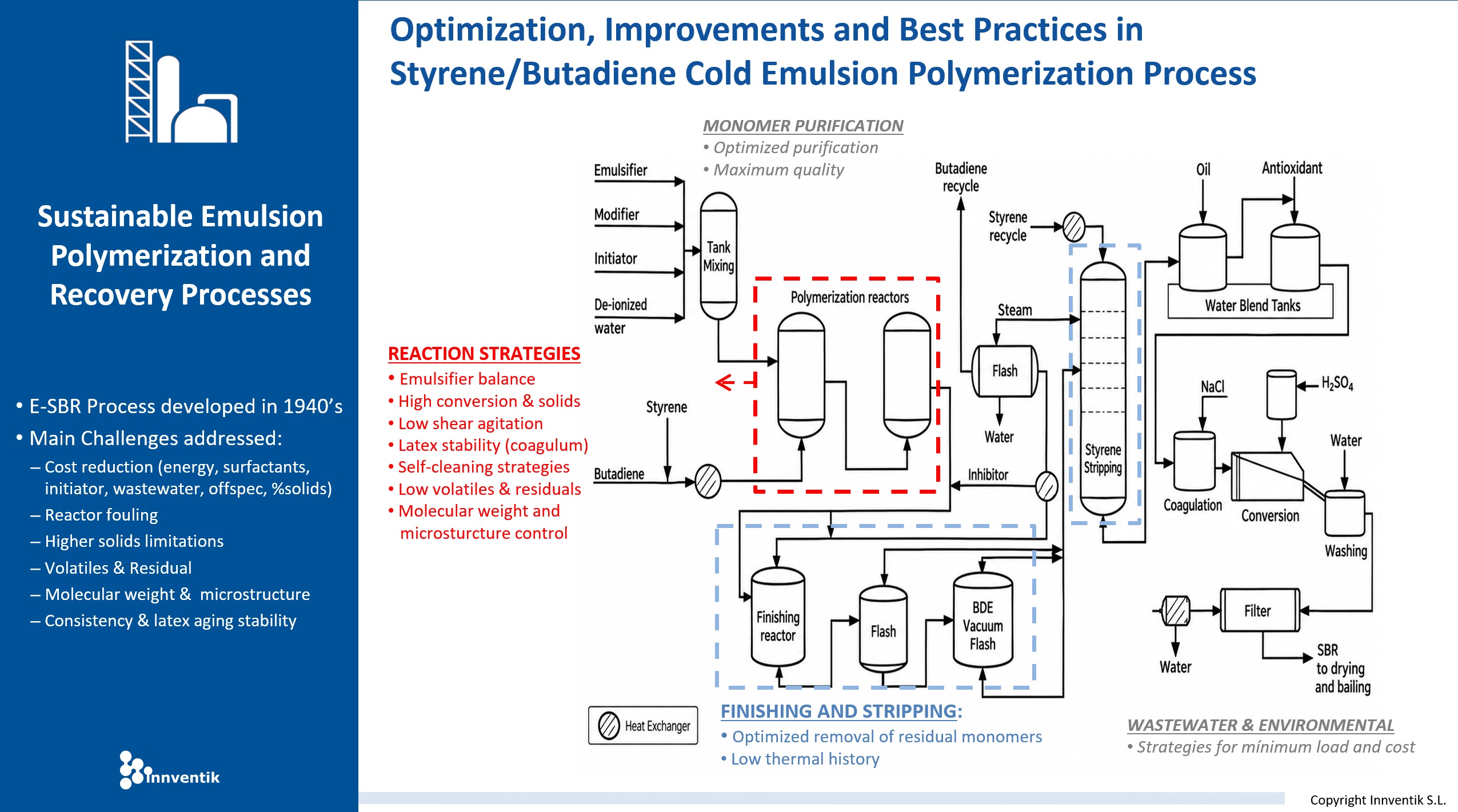
An effective ESBR optimization program should therefore address the complete production chain—from raw-material preparation and polymerization through monomer recovery, coagulation, dewatering, drying and finishing—while considering the interactions between these operations. Key areas include emulsifier balance, conversion and solids, agitation, latex stability, fouling, residual monomers, monomer purification, stripping and finishing, and wastewater management.
The objective is straightforward: produce more consistently, at lower cost, with existing assets whenever possible, while creating the flexibility required to manufacture differentiated and higher-value grades.
Where is value typically lost in an ESBR plant?
The first step in process optimization is not immediately proposing new equipment or technology. It is identifying the actual constraints of the plant. Typical questions include: What is the plant’s critical bottleneck? What percentage of production is off-specification, downgraded or reprocessed? What prevents operation at higher conversion or higher solids? Which operation has the greatest impact on production cost or capacity? Where can product differentiation generate additional value?
The answers are rarely associated with a single unit operation. Monomer purification and recovery, Polymerization kinetics, heat removal, fouling, latex stability, residual monomer removal, coagulation behavior and finishing capacity are interconnected. Improving one area without considering its effect on downstream operations can simply move the bottleneck elsewhere. For this reason, process optimization should evaluate the plant as an integrated system and distinguish between the different mechanisms through which value can be created.
A structured framework for process optimization and cost reduction
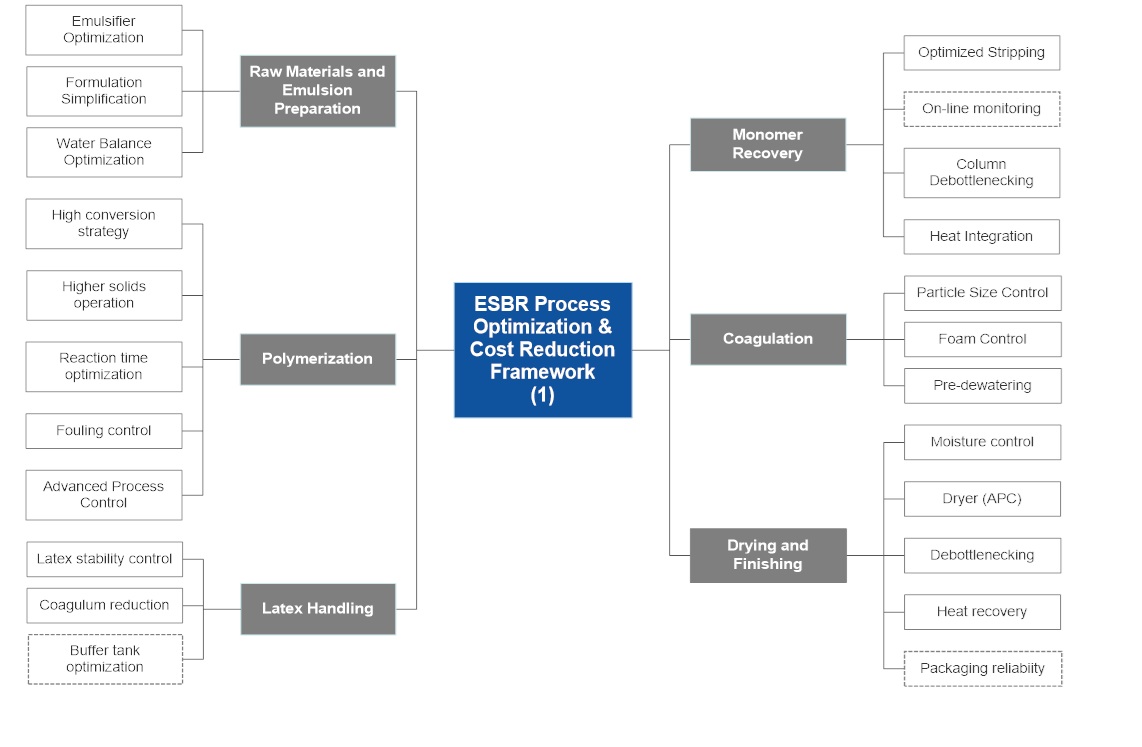
ESBR process optimization begins with understanding how the individual operating variables and unit operations affect overall plant performance. The objective is to identify improvement opportunities systematically rather than addressing individual symptoms in isolation. The optimization framework considers the relationships between polymerization performance, operating stability, capacity utilization, raw-material efficiency, utilities, recovery and downstream processing. This allows technical opportunities to be linked to specific economic objectives such as increased production, reduced variable cost, lower off-specification generation or improved plant availability.
The first group of opportunities is associated directly with the polymerization section, where batch cycle, conversion, reactor utilization, heat removal, fouling and process variability can determine both capacity and manufacturing cost.
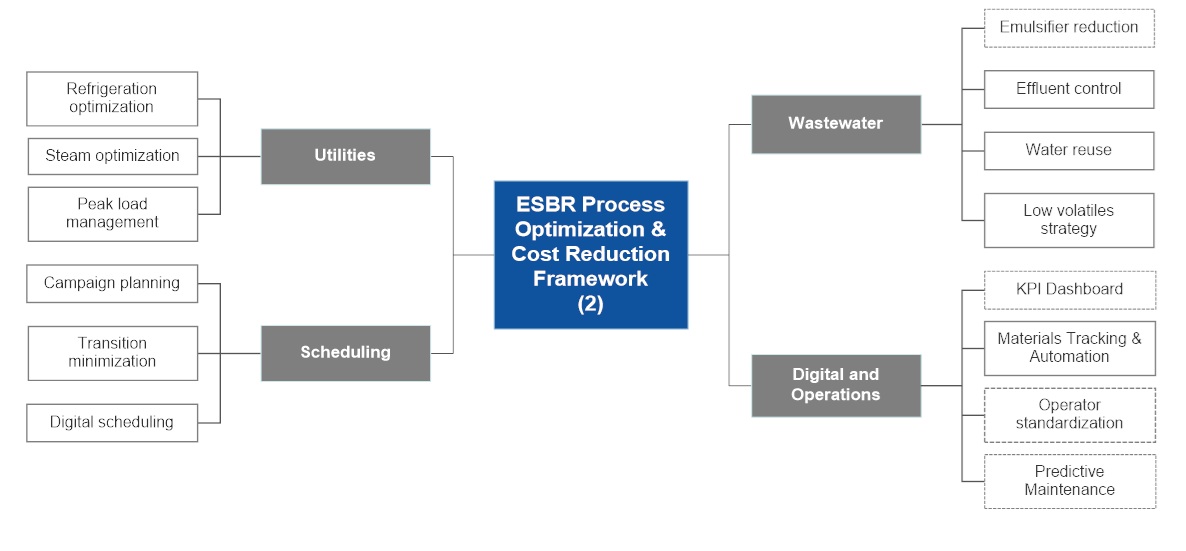
Optimization should not stop at polymerization. Monomer recovery, refrigeration and energy systems, coagulation, dewatering, drying and finishing can become equally important constraints.
This second level of analysis is particularly important when upstream improvements increase production. Additional polymerization capacity has limited economic value if monomer recovery or finishing subsequently becomes the bottleneck.
The complete process must therefore be evaluated as an interconnected production system, identifying where changes in one area affect capacity, energy consumption, product losses, quality or operating stability elsewhere.
Key opportunities for ESBR process optimization
Several areas repeatedly offer opportunities for improvement in established ESBR plants. These include batch-cycle optimization, conversion improvement, higher solids, fouling reduction, heat-removal optimization, monomer recovery, energy integration, coagulation efficiency, drying and finishing debottlenecking, grade-transition optimization and new-grade development.
Polymerization cycle and reactor utilization
Batch-cycle optimization can directly increase effective plant capacity without installing additional polymerization reactors. The analysis should identify the individual contributions to total batch time and distinguish necessary reaction time from waiting, preparation, transfer and other non-productive periods. Cycle-to-cycle variability is equally important: reducing average cycle time provides limited benefit if process variability prevents consistent scheduling and reactor utilization. Optimization therefore involves both cycle-time reduction and cycle consistency.
Conversion, solids and polymerization stability
Increasing conversion can reduce residual monomer loads and improve plant productivity. Higher solids can also increase effective capacity and reduce the amount of water handled downstream. However, these improvements cannot be pursued independently of latex stability, heat removal and fouling. The polymerization system must maintain the appropriate balance between emulsifier chemistry, initiation system, agitation, heat transfer and reaction kinetics. Higher conversion or solids becomes economically attractive only when it can be achieved without unacceptable increases in coagulum, reactor fouling, instability or batch variability.
Reactor fouling and heat removal
Reactor fouling has consequences beyond cleaning costs. Deposits progressively reduce heat-transfer performance, potentially increasing batch time, affecting temperature control and contributing to variability between campaigns. Cleaning requirements also reduce plant availability. Consequently, fouling should be evaluated together with reactor hydrodynamics, heat-transfer performance, cooling/brine control, recipe conditions and latex stability rather than treated exclusively as a maintenance issue.
Raw-material and monomer quality
Polymerization performance begins upstream of the reactor. Variations in monomer, water, emulsifier and initiator quality can influence reaction rate, conversion, latex stability and overall process consistency. Purification requirements and recycle streams therefore need to be considered as part of the polymerization system. The objective is not necessarily maximum purification everywhere, but consistent raw-material quality appropriate for stable polymerization and the required final-product specifications.
Monomer recovery and stripping
Residual styrene and butadiene represent both a product-quality issue and an economic loss. Optimization of flash and stripping operations can improve monomer recovery while reducing energy requirements and stabilizing recycle-stream quality. The interaction between conversion and recovery is particularly important: polymerization conditions determine the residual-monomer load that the recovery section must subsequently process. An integrated assessment should therefore consider polymerization conversion, stripping efficiency, recycle purity and energy consumption together rather than as independent optimization problems.
Coagulation, water management and finishing
Coagulation strongly influences downstream equipment performance. Variability in crumb formation, particle size or foaming can affect washing, dewatering and drying. Poor coagulation performance may consequently appear downstream as excessive moisture, dryer limitations or unstable finishing operation. Finishing can also become the effective capacity limitation when upstream production is increased. Moisture variability, insufficient dewatering, dryer efficiency and frequent interruptions can restrict throughput even when polymerization capacity is available. The correct approach is therefore to evaluate coagulation, dewatering and drying as an integrated system.
Energy integration
ESBR production requires significant refrigeration, steam and other utilities. Energy optimization should therefore extend beyond individual equipment efficiencies. Particular attention should be given to refrigeration systems, heat integration, steam consumption and the relationship between operating conditions and utility demand. Historical plant data can be used to establish specific energy consumption against production rate and grade and determine whether utility systems themselves constrain production.
Cost reduction is only part of the opportunity
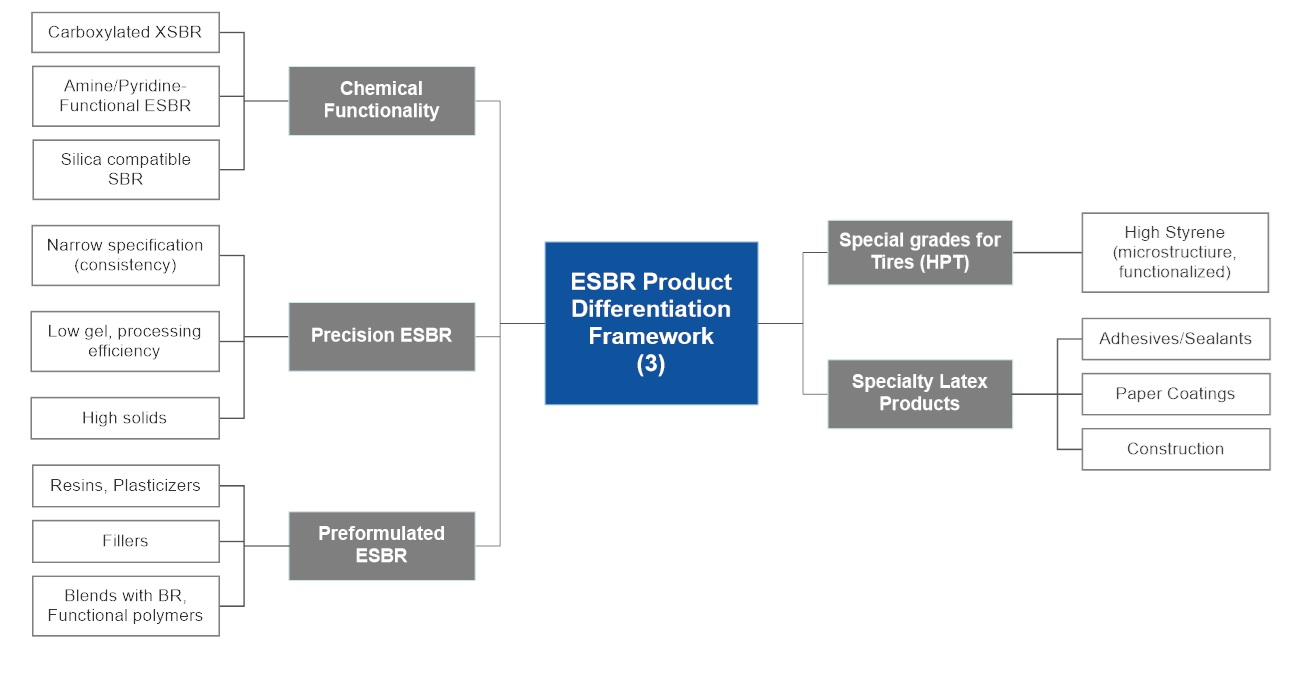
Optimization programs frequently begin with a cost or capacity objective. However, an established ESBR plant can also be evaluated from a product-differentiation perspective.Once the process operates consistently, the same understanding of polymerization chemistry, molecular-weight control, microstructure, emulsifier systems, conversion and finishing can be applied to determine whether the plant can manufacture grades targeted at more demanding or higher-value applications. This changes the question from:
“How can we manufacture the existing grades more cheaply?”
to:
“What additional products can this asset manufacture competitively?”
Potential differentiation must be evaluated against the real capabilities of the existing polymerization and finishing systems. In some cases, modifications to recipes and operating conditions may be sufficient. In others, targeted process modifications may be required. The important point is that process optimization and product development should not necessarily be treated as separate activities. Improved process control and consistency can create the operating window required for new product development.
From process optimization to measurable business value
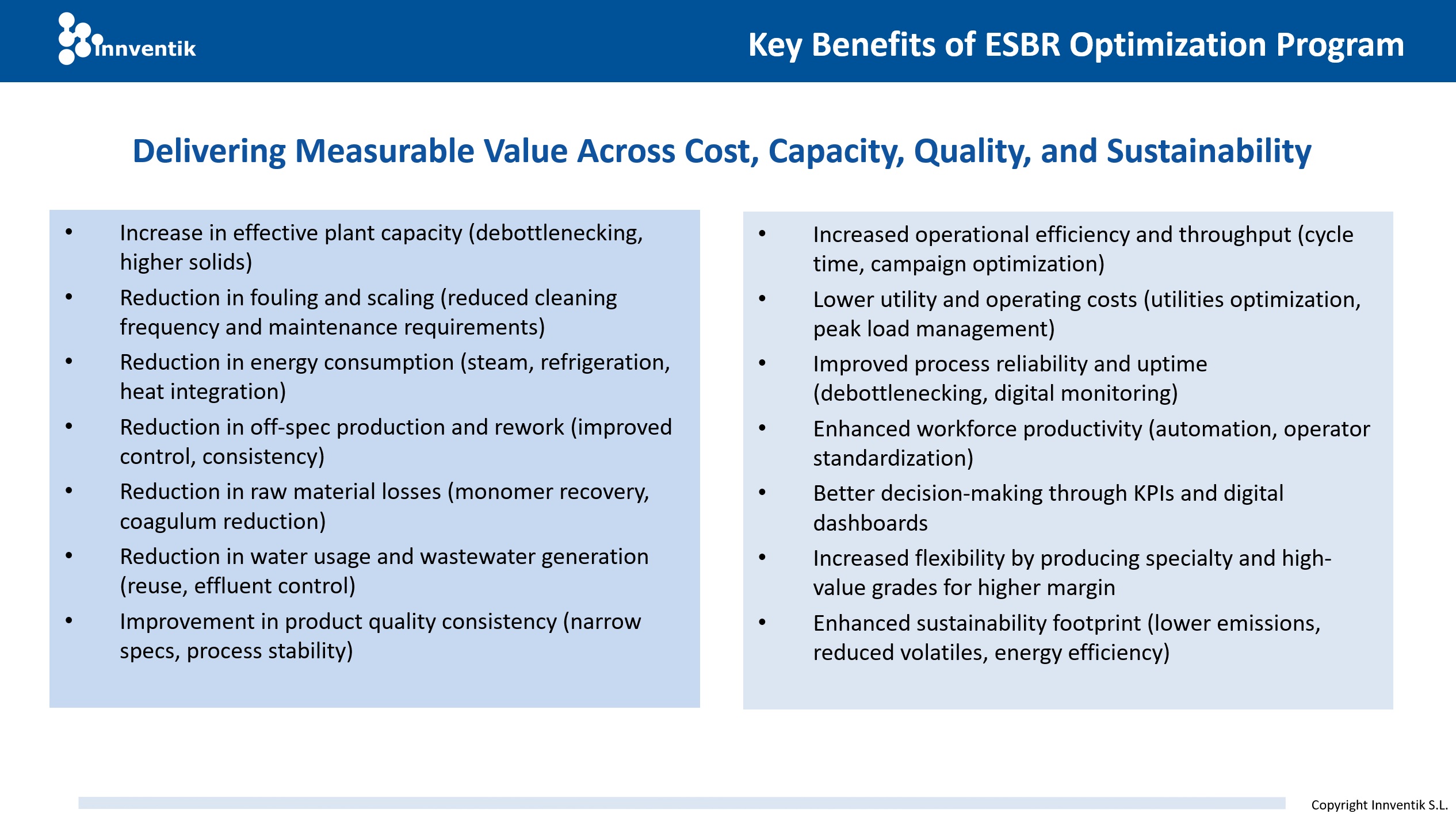
The purpose of the assessment is not simply to identify technically interesting improvements. Each opportunity should ultimately be translated into operational and economic value. Depending on the plant, potential benefits include increased effective production capacity through debottlenecking and higher solids; reduced fouling, cleaning frequency and maintenance; lower steam and refrigeration consumption; reduced off-specification production and rework; lower raw-material and monomer losses; reduced water consumption and wastewater generation; improved product consistency; increased reliability and uptime; greater workforce productivity; and increased flexibility to manufacture specialty and higher-value grades.
The objective is therefore to move from individual technical observations to measurable value across cost, capacity, quality and sustainability.
A structured ESBR Process Assessment
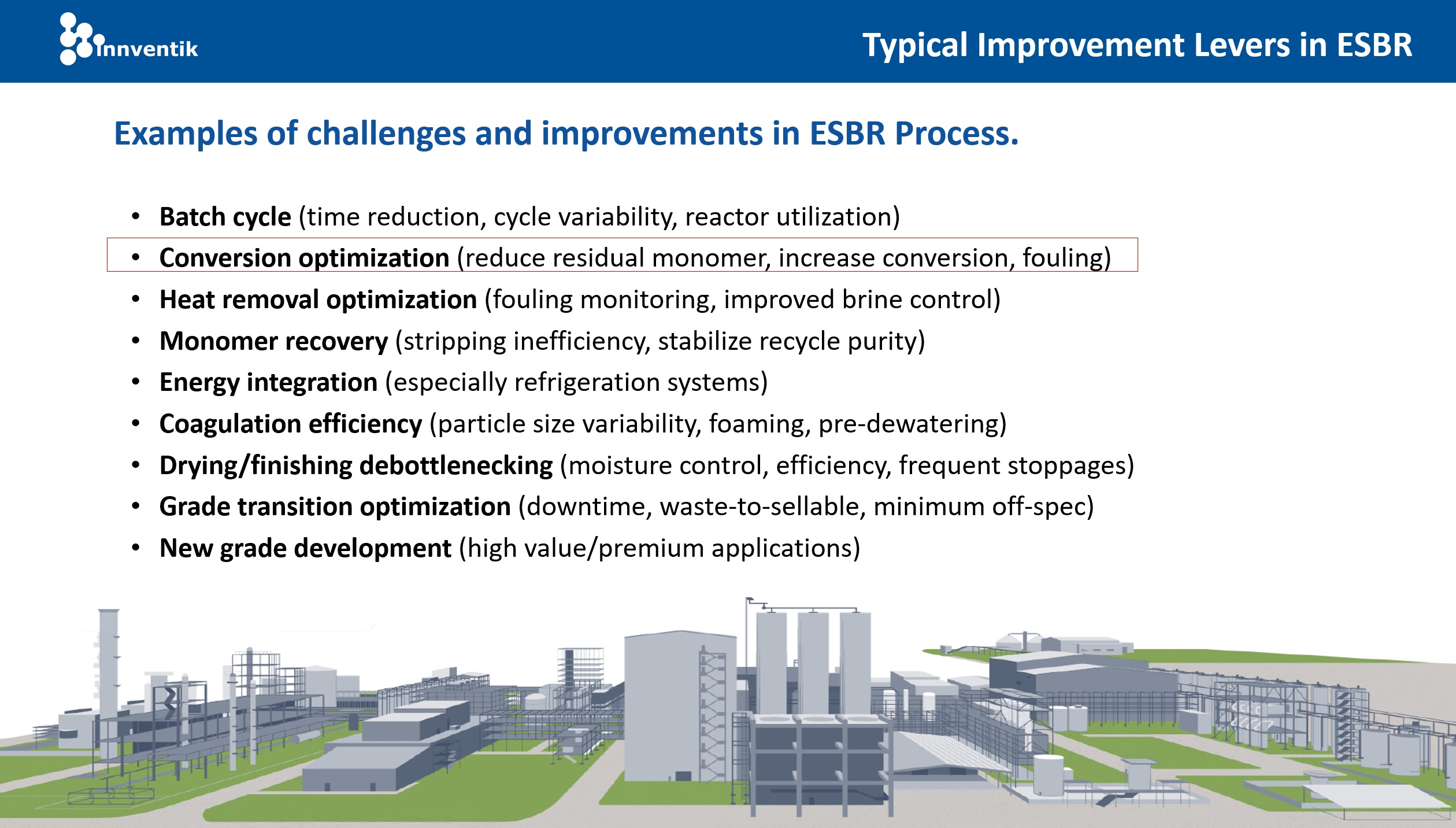
The specific improvement levers will depend on the configuration, product portfolio and operating history of each plant. Typical areas include batch-cycle reduction, conversion optimization, heat-removal performance, monomer recovery, refrigeration and energy integration, coagulation efficiency, drying and finishing debottlenecking, grade-transition optimization and new-grade development.
Innventik’s methodology starts by defining objectives, plant boundaries and KPIs. Historical production, quality and utility information is then combined with operating procedures, recipes, plant observations and discussions with operating personnel.
The process is mapped from raw materials through finished product, and actual performance is compared against expected or theoretical performance. Bottlenecks and losses are validated using plant data rather than assumptions.
Root causes are subsequently analyzed and potential improvements benchmarked against industry practice. Opportunities are quantified and prioritized according to impact and implementation effort, distinguishing relatively fast operational improvements from modifications requiring engineering or capital investment.
The result is an implementation roadmap, rather than simply a list of observations. The assessment methodology progresses from objectives and data collection through process mapping, performance analysis, bottleneck identification, root-cause analysis, benchmarking, opportunity identification, prioritization and recommendations.
Evolving existing ESBR assets
Many ESBR plants have operated successfully for decades. Their age does not necessarily mean that their fundamental technology needs to be replaced.
The opportunity is often to understand how the existing process actually performs today, identify the interactions limiting its performance, and selectively introduce better operating practices, process modifications, automation or advanced technologies where they generate demonstrable value.
For ESBR producers, this provides a practical route to extend the competitiveness of existing assets: reduce production cost, recover latent capacity, improve consistency and reliability, reduce environmental impact, and create the process flexibility required for differentiated products.
Author: Dr. Walter Ramirez, Managing Partner, Innventik S.L. (walter@innventik.com)